On October 31st we made a trip with our class to "Meadowlark Field" in Sebastopol that belongs to the Laguna de Santa Rosa Middle Reach Restoration Project. As a curious note, I found out later that the name "Meadowlark" is the translation into English of the word "whitsé la holma noma" of the Mishewal-Wappo language and is the way that native americans used to call the Santa Rosa area.
That day two hard working volunteers from ENSP class are singing in the rain!!!! and pulling irrigation lines from Meadowlark Field!!!!
Wednesday, November 5, 2014
Tuesday, November 4, 2014
Blackberry Blog 9-19-14
Copeland Creek Restoration Grant Proposal Blog
Blackberry Day 1 & 2
Cameron Keyser, Nicole Bickham & Amanda Sanfilippo
This was the first day in the field of our restoration project at Copeland Creek. We started the day by having a pre-game talk about past restoration on Copeland Creek and the treatments that were used. The main concern for this project was the removal and reduction of the exotic invasive Himalayan Blackberry (Rubus armeniacus) along certain areas of Copeland Creek. We observed plots along the creek that were previously treated, and we collected data on the invasive and native species composition and richness. We did this by counting and recording the invasive species in a given plot. There were 9 different areas, 36 plots that were 3m x 3m, and 4 different treatments used.
The photo above is the target site on 9/19/14. There is no water in the creek. We saw many invasive species that lined the borders of this creek. This is a picture looking downstream, or toward Snyder Lane.
This is our teacher’s assistant Meghan showing off her best corny nature t-shirt. We had a contest of who had the best nature shirt, and there were some good ones. I don’t believe we ever declared a winner though! (Photos Above)
In this picture, we are all standing on the pathway next to Rancho Cotati High School and we are discussing how to determine which invasive species are in the plots.
Here, we are listening to our great teacher, Caroline Christian, discuss invasive species at the creek. There were many bikers on this path, so Ruben yelled “biker!” at least 20 times.
Our instructions were to collect 10 different plant species along the creek to identify. Here, Kevin G. (top) is taken aback by the vast number of invasive species present, and bottom photo, students get their bags of plant species carefully identified by Caroline.
As Caroline talked to us about the different plant species, we kept a field journal and examples of specimens to compare to the species located in the plots. The non-native Lactuca serriola (seen in bottom photo) is one of the more abundant species in this area of Copeland Creek.
Here, (top) is an example of one of the plots that we worked with. The PVC pipe is the center, while the pink flags are the four corners of the plot. The above right photo shows a group of students working on a plot that is has much higher plant species richness and composition than the above left picture. As you can see, Kevin H. is pretty thrilled about identifying all of those plant species! (bottom)
Syd, Melina, and Chelsea (top) and Cameron (bottom) are all working hard to correctly identify all of the plant species present in their plot!
Some of the restorationists working in the field (top).
This was the data sheet that we filled out the species composition for each plot. One of the target plots is in the background (bottom).
Monday, December 10, 2012
December 7, 2012 PLD Plot Data Day
The following documentation presented to you by: Nick Darst, Todd Harney, Kolaan Busbice, and Matty Gillan.
In order to reduce redundancy, see post titled Himalayan Blackberry Control Experiment by Kolaan Busbice for a detailed description of the day.
![]() |
| Dr. Caroline Christian with the pregame speech to pump up the team of restorationists. Apparently a few did not have their coffee that morning. |
![]() |
| Going over materials before setting out for data collection. |
![]() |
| In order to get consistent data everyone needed to be on the same page from the get-go |
![]() |
| Watch out for the bike! |
![]() |
| Ingenuity at its finest. |
![]() |
| After initial data was collected, the treatment of clipping was applied. |
![]() |
| A fully clipped plot. |
| The bloggers diligently bringing you this here information. |
![]() |
| Meanwhile, a little more south of our study site, one student was acting as an exotic (maybe invasive?) species. |
Sunday, December 9, 2012
Himalayan Blackberry Control Experiment
The Sonoma State Restoration Ecology Class woke up to
a sunny morning following an extensive rainstorm. The Sonoma State ENSP
department is gathering baseline data for a Himalayan Blackberry (Rubus armeniacus) Control Experiment.
The purpose of the experiment is to restore a patch of vegetation parallel with
Copeland Creek, spanning from Sonoma State to Snyder ln. The restoration
ecology students were armed with the task of collecting data to test for any
variance among plots before the experiment is treated with herbicide.
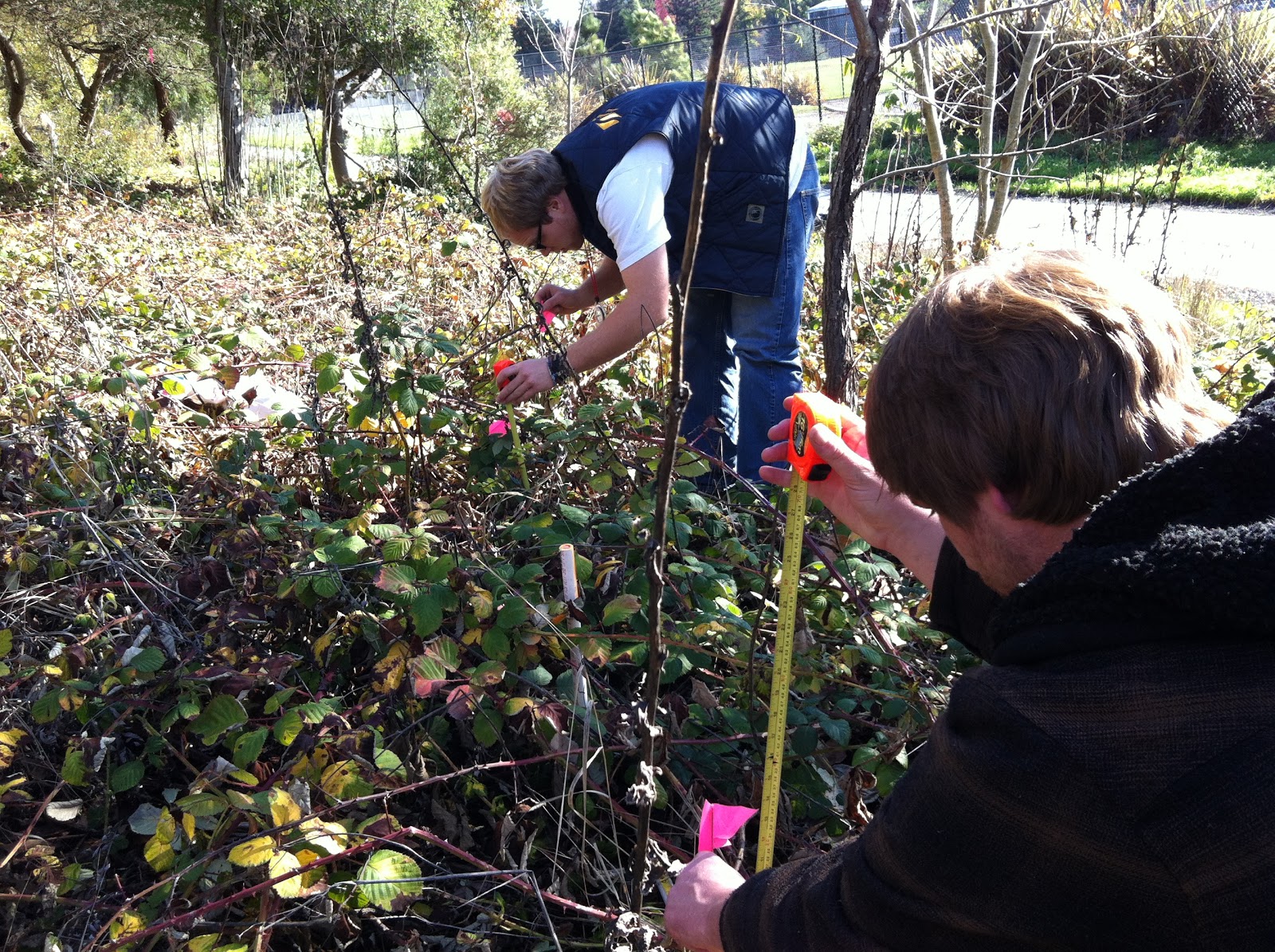
Students Jerry-rigging a transect line to a PVC
pipe:
By the day’s end, students were expected to collect data for two sample blocks (4 plots per block).
Students preparing equipment for a sunny day in the
blackberry thickets:
Himalayan Blackberry is one of California’s most
invasive shrub species. It is found all over Sonoma County, and can create many
problems due to its high growth rates. Himalayan Blackberry is hated for its
thorny structure, but is appreciated by the community for its sweet summer
fruit.
Plots were previously marked by PVC markers:
Many of the plots contained very dense Blackberry
growth, and made it difficult for students to maneuver without getting pricked
every step. Students used a transect line, measuring tape on PVC that was
threaded through the base of each blackberry thicket, to accurately record
different aspects of growth for 9 sample blocks.
Nick and Bryan in sampling action:
Data was recorded using a point-intercept sampling
method. Students used marking flags to systematically note cane density in each
sample plot.
Foot traffic accompanied by puzzled faces and
curious dogs was a regular occurrence throughout the day:
Data collection for the day was an extensive
process, but was successful to say the least. The control of Himalayan
Blackberry along the Copeland Creek jogging path will create open niches for
desired plant species, and give joggers a more diverse scenery. Data collection
also offered additional practice for students aspiring to work in the field
following graduation.
Now that the baseline data was documented, efforts
will be allocated to the removal of Blackerry from each plot. With future help
from Sonoma State’s ENSP department, Copeland Creek will receive a much needed
overhaul.
Friday, November 30, 2012
Early Friday morning, Restoration Ecology students loaded into some
luxurious rental cars and headed north on the 101 towards the isolated
town of Boonville California. Destination, The Garcia River Forest in Mendocino County.
Just under 10 years ago, in 2004 The Conservation Fund, an environmental non-profit organization, bought 24,000 acres of Redwood and Douglas Fir forest which became California's first large nonprofit-owned working forest. Only 4 years later it became certified under the Climate Action Reserve as a source of green house gas reduction. This means that Garcia River Forest receives funding through a system known as carbon taxing which pays you not log trees because of carbon sequestration. But the interesting thing is that Garcia River Forest also gets money from sustainable timber harvesting, so it works out that they are payed to leave most trees in place but are also paid for some selective logging.
But instead of clear cutting, Garcia River Forest practices sustainable forest management through Selective Harvest methods known as silver culture logging. With this, Group Selection Units, or groups of trees are carefully chosen for logging. Many regulations are in place prohibiting logging of certain trees especially those that are suitable Spotted Owl or Marbled Murrelet habitat described to be dense dark stands of Redwoods or large Douglas Firs with wide limbs. Northern Spotted Owl Habitat has various regulatory categories, such as nesting or roosting habitat, and plays a big role in tree harvest selection. Garcia River Forest logging practices are very monitored and are required to abide by California Forest Practice Rules and huge effort is put into putting together CEQA documents.
Various restoration projects are in place on the property including logging road maintenance and culvert installation. We also saw how they improved salmon habitat by placing trees so that a portion of them is in the creek.![]()
Garcia River Forest has a unique system that exemplifies how environmental policies and economic incentives can be utilized to maintain a healthy and working forest.
Just under 10 years ago, in 2004 The Conservation Fund, an environmental non-profit organization, bought 24,000 acres of Redwood and Douglas Fir forest which became California's first large nonprofit-owned working forest. Only 4 years later it became certified under the Climate Action Reserve as a source of green house gas reduction. This means that Garcia River Forest receives funding through a system known as carbon taxing which pays you not log trees because of carbon sequestration. But the interesting thing is that Garcia River Forest also gets money from sustainable timber harvesting, so it works out that they are payed to leave most trees in place but are also paid for some selective logging.
But instead of clear cutting, Garcia River Forest practices sustainable forest management through Selective Harvest methods known as silver culture logging. With this, Group Selection Units, or groups of trees are carefully chosen for logging. Many regulations are in place prohibiting logging of certain trees especially those that are suitable Spotted Owl or Marbled Murrelet habitat described to be dense dark stands of Redwoods or large Douglas Firs with wide limbs. Northern Spotted Owl Habitat has various regulatory categories, such as nesting or roosting habitat, and plays a big role in tree harvest selection. Garcia River Forest logging practices are very monitored and are required to abide by California Forest Practice Rules and huge effort is put into putting together CEQA documents.
Various restoration projects are in place on the property including logging road maintenance and culvert installation. We also saw how they improved salmon habitat by placing trees so that a portion of them is in the creek.
Garcia River Forest has a unique system that exemplifies how environmental policies and economic incentives can be utilized to maintain a healthy and working forest.
Thursday, November 29, 2012
Laguna de Santa Rosa Field Trip!
On November 16, 2012 students of the Restoration Ecology class gathered at Balletto Winery, eager to learn about the Laguna de Santa Rosa and even flex their muscle to help restore portions which have been invaded by non-native species such as Himalayan Blackberry
As the day began and the students energized, running off of coffee and enthusiasm (except for Nick mid yawn) and received a breakdown of the days events from Brent Reed, Restoration supervisor of the Laguna de Santa Rosa Foundation
The first stop was at Kelly farm to observe three man made waste water pools designed in the early 90's to naturally diffuse water and abstract unwanted nutrients and bacteria using bull rushes, cattails, willows, and cottonwoods. The waste water is diverted from the city of Santa Rosa and used to irrigate large fields for hay production for neighboring farms throughout the county of Sonoma
Next stop was the Duer creek restoration site just south of the Kelly farm ponds, an active site overseen by the Laguna de Santa Rosa Foundation attempting to widen the riparian corridor to provide habitat for native birds and other animals in the Laguna as well as help suppress the extreme invasion of Harding grass, Prickly lettuce, Teasel, and Curly Dock. Seen in the picture above are Coyote Bush (Bacchris pilularus), Oregon Ash (Fraxinus latifolia), Valley Oak (Quercus lobata), rose (Rosa californica), Elderberry (Sambucus mexicana), and Box Elder (Acer negundo). The strips of dead brown foliage between plants is a result of the Foundation's attempt at suppressing weeds to allow the native plants to grow using a chemical mixture of Chateau, Rodeo, and Li-700 sprayed using backpack sprayers.
After a wonderful bathroom break at the Chevron the students were eager to enter the Meadowlark restoration site, the largest active site overseen by the Foundation
Students were able to observe the growth and success of plants from 2006-2012 and the vast irrigation systems installed to help establish these native species. Here the explanation of how funding such a vast project was explained as various funding sources such as the Sonoma County Open Space District, Cal Trans, and the City of Sebastopol.
FINALLY! It was time to get down and dirty with some Himalayan Blackberry. Students jumped at the opportunity to grab a pick-axe, shovel, or McCloud and rip away at the invasive species seen here growing over fallen oak tree trunks. It was a fulfilling and satisfying feeling to do their part and help restore the Laguna de Santa Rosa with their own hard work and dedication!
Do you feel luck...punk...do ya?
Todd.....aka The Restoration Man. With his camo beanie, tooth necklace, and shears he can destroy any invasive species in his path...in mere seconds..
and his helpful side kick....Shovel Boy!!!
and Shovel Boy's dependable side kick....Captian Matty!
At the end of the day the students of Sonoma State's 2012 Restoration Ecology class were tired, cold, wet, and dirty. But they never felt better. The blackberry was knocked back and they even helped save a California Buckeye tree from being engulfed by the fast growing canes of the Blackberry. They all slept a little bit better that night knowing the service they did in helping the Laguna de Santa Rosa Foundation help restore their largest site known to date. The Blackberry was down...but certainly not out. In just a few months the evil exotic species will surely return and wait for the right time to invade again. Until next time, when the students of Caroline Christian's class come back to serve their duty and restore the Laguna once more.
Monday, November 26, 2012
Restoration of the Garcia River Forest
On November 9, 2012, our
class had the opportunity to explore the Garcia River Forest restoration
project. We began our trek driving north on the 101, then hung a left towards
Booneville, all the while hoping that we would be spared the forecasted heavy
rains. Upon entering the Garcia River Forest with our guide, Madison from the
Conservation Fund, I had little inclination that the surrounding trees had at
one point been completely deforested.
| Ingrid, Faye Marie, and KC surveying the landscape. |
At
our first stop, Madison explained how the 24,000 acre forest was purchased from
a lumber company in 2004 and since then, the Conservation Fund has succeeded in
restoring it to a functional ecosystem while still profiting from harvesting
timber.
Before harvesting timber, the Conservation Fund must write a Timber Harvest Plan to be approved. Some people often protest against harvesting timber because they are concerned of cutting down old growth and habitats of spotted owls or other endangered species. However, the public relatively approves of their plan in the Garcia River forest because the Conservation Fund encourages public input and hosts hikes to show and explain their plan.
Selective harvesting is not actually healthy for the forest. Choosing the healthiest and biggest trees will result in a weaker population of trees. Instead, they mimic a natural burn and select an entire area of trees and cut them all down so that the new generation of trees has the ability to start again with an even playing field instead of competing with older generations. However, they do try to select trees that are damaged by disease, insects, and fire first.
![]() |
| Felicia's Fungi Finds |
The
Conservation Fund produces another source of income by selling their earned carbon credits. They are given a limit of trees possible to harvest through the California Climate Action Registry. When they harvest fewer trees than their limit, they are given carbon credits that can be sold to make a profit. In this way, the organization can raise money for maintenance and restoration projects on the property all while carbon is sequestered by the redwood and Douglas fir forest.
At the end of the day, our Restoration Ecology class gained a new appreciation and a lot of knowledge of a functional forest restoration project. We give thanks to Madison, the Conservation Fund, and the other non-profit organizations that provided the opportunity for such a great experience.
Subscribe to:
Posts (Atom)